WOOOOOOOO, we made it!!!
We just finished the first offering of BIPN 103, Human Anatomy w/ Lab, and I also completed my first year as a professor. This caps off a year in which each quarter brought new challenges that built upon the last. In Winter 2025, I taught BIPN 100, my first time being the solo instructor of record for a class. Thankfully, BIPN 100 was a well-established course that had been taught for several decades, giving me a clear recipe to follow. In Spring 2025, I added on a newer course, BILD 5, and for the first time juggled teaching two different courses simultaneously. That said, BILD 5 was already designed and piloted by my colleagues Liam Mueller and Keefe Reuther, and I knew I had a great class in my hands even before I started. And finally, with Fall 2025 came the final boss – alongside my colleague Carlos Rojo, we created a brand-new course from the ground up – BIPN 103 Human Anatomy w/ Lab.
Getting to create something brand new like this was both thrilling and extremely terrifying. For reasons I don’t fully understand, UCSD has historically never offered an undergraduate course in human anatomy. As a result, students who wanted (or needed) to take anatomy would pay to take the course elsewhere, either through a community college or through UCSD Extended Studies. This was evidently a big gap in our undergraduate biology program, and Carlos and I were tasked to fill it.
Carlos and I were given near complete creative freedom to design the class however we wanted. The main constraint was that the course needed to predominantly be a dry lab, making use of physical models and virtual reality as opposed to wet-lab dissections. (The department had invested in 24 VR headsets shortly before I was hired, so I didn’t have much say in this early decision — nonetheless, I was enthusiastic to explore how to teach with VR). I was also perfectly happy with the dry-lab format. I have qualms about whether cadaveric dissections truly have a place in an undergrad’s first-course in anatomy — my hunch is that the fine motor demands of learning how to dissect can actually distract from learning the underlying anatomy, especially in a compressed 10-week course. As such, I’d prefer that these valuable body donations be prioritized for postgraduate medical training rather than for teaching undergrads. A separate but related constraint was that our course had to be designed with future scalability in mind. Even though our pilot offering was a single section of 48 students, we anticipated the course eventually growing to accommodate hundreds of students a quarter (UCSD has upwards of 6000 biology majors, and we expected a large backlog of demand to take this class).
This creative freedom to do whatever we wanted was extremely liberating. But with that freedom came paralyzing, paralyzing imposter syndrome. When I joined UCSD in November 2024, I knew that we were working towards a September 2025 launch date for the course. In theory, I should have been working steadily throughout the year to build out the course. In practice, I was just so terrified about starting the work that I just procrastinated and procrastinated, focusing all my attention on my other responsibilities and delegating no time at all to BIPN 103. Even though rationally I knew I was super excited to start creating, staring at the blank canvas just sent a whole cascade of doubt swirling in my mind: am I really the right person to do this? (I’m hardly an anatomist myself, and my own anatomy knowledge is spotty at best. I took most my preclinical courses virtually during COVID, and I only considered myself truly knowledgeable two or three organ systems – with no knowledge whatsoever about the others. Heck, I barely knew the names of any bones, because there was just never any reason for me to learn them). To what extent would this course define my reputation at UCSD, and how bad would it be if we just colossally screwed this up?
Thankfully, I wasn’t in this alone, and I was able to talk out all these feelings with Carlos, who completely understood where I was coming from. Ultimately, we tried to reframe our experiences as assets rather than weaknesses. Since both of us would have to learn a significant amount of material before we could teach the class, it gave us the opportunity to critically examine what we even wanted to teach in the first place. We got on many information-gathering calls with anatomy instructors at PT schools, med schools, and I spoke with some of my own friends who were in medical school or working in healthcare, for instance as radiology technologists. Unsurprisingly, a prevailing theme across all these conversations was a frustration that most anatomy courses were far too information-dense, incentivizing rapid cramming followed by a swift data dump shortly after.
Naturally, people differed in what they considered to be the most essential content. For example, a medical student I spoke with questioned the value of memorizing every muscle’s origin and insertion in her anatomy course, whereas physical therapists emphasized the importance of this. Similarly, a med student thought it was silly to memorize bone markings and identify left- versus right-sided bones in isolation (disarticulated from the body), whereas an x-ray technologist saw these skills as practical and useful. From these conversations, two priorities emerged for me. First, I wanted our course to serve students of all post-grad aspirations, not just those pursuing MDs. Sometimes, I feel like our undergraduate courses cater too heavily towards pre-med as the ‘default’ career path, and other career pathways are overlooked — coincidentally, these other professions are usually the ones that actually require an undergraduate anatomy course, whereas for pre-med it is just a soft recommendation. Therefore, I wanted all of our students to walk away feeling like their own career goals were considered and represented in the course design, not merely those pursuing allopathic medicine. Second, beyond just learning anatomical jargon, I wanted our students to see the forest for the trees, building an intuitive mental model of the human body. As such, Carlos and I focused on emphasizing core anatomical concepts (e.g., providing a few illustrative examples to predict a muscle’s expected movements based on its origin and insertion) rather than relying on brute memorization (e.g., rote-learning all the origins and insertions of every muscle).
With the learning objectives streamlined, it was time to start fleshing out the course content. I’ll expand on the course structure in a future blog, but in brief, Carlos and I agreed that BIPN 103 was well-suited to a flipped classroom format. Since the course topics were so dense, we felt it would be ineffective to deliver the content as live lectures — instead, for every topic, we created a playlist of 5-10 videos that students watched before class time to learn all the material. Each video was 8-15 minutes long, and contained lots of interspersed questions to check students were paying attention as they watched (Fig. 1).
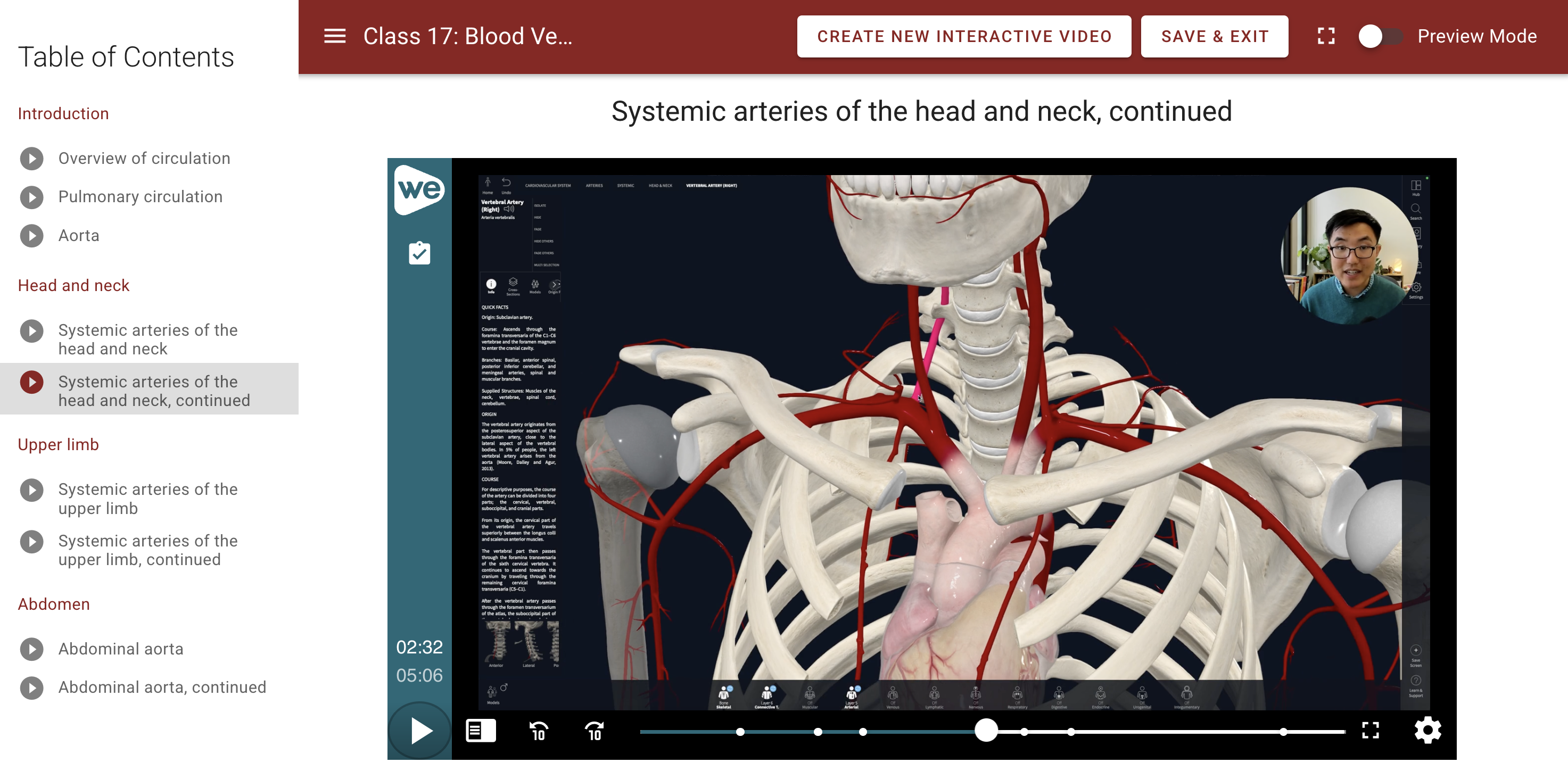
Fig. 1 Sample pre-course video
Then, during our scheduled ‘lecture’ time, students collaboratively completed worksheets with exam-style questions. After that, during lab, students saw the concepts come alive in 3D, playing with physical and virtual reality models. “Play” is the critical word here — both Carlos and I wanted lab sessions to embrace learning through play, using creative activities like clay modeling and even body painting. We wanted lab to be a truly stress-free environment where students could focus on learning for the sake of learning, without the scrutiny of performance-based grades.
Reading this back, it almost seems foolish to commit to a full flipped class right off the bat, since this required us to generate a truly enormous amount of content. Ordinarily, developing all these materials is one of my favorite things about teaching — I love iterating on the narrative of my lectures, polishing the design of my slides, creating assessment problems and in-class activities, and integrating all these components into a cohesive experience for the students. But even for me – and even with this being a team effort – the volume of content to create was incredibly overwhelming. By the time the quarter started, we had most the course materials prepped up to week 4, and I knew I had to make this head start last as long as possible. In short, work-life balance did not exist this quarter. I spent every weekend going to a different coffee shop, frantically learning the material myself, making lecture slides, in-class worksheets, lab activities, trying to drag out this headstart as much as possible. There were many lab sessions where the plans were only set in stone the night before. And although the work was creatively fulfilling, and as much as I knew this upfront effort would pay off in the future, I was completely exhausted by the end of the quarter.
Unsurprisingly, what kept me going was seeing my students wholeheartedly embracing the class. Early in the quarter, I worried that some of the lab activities might feel too childish and lead to disengagement. Although I was excited about things like sculpting muscles with clay or painting arteries on each other’s bodies, I wondered if the students would feel patronized and think it all felt a bit too elementary school. Thankfully, the opposite was true. The students dove headfirst into each activity and really had fun with it — it just felt SO awesome to see the students laughing with each other as they reenacted physical therapy exercises, or made clay muscles and silly moustaches for the skeleton models, or turned vertebrae models into finger rings. At the end of the quarter, one of my students told me that this course “relit her spark”, and I will honestly cherish that comment forever.
What made the experience extra special was having a small class of just 48 students. In my other courses, enrollment routinely exceeds 200 students, so I’ve come to accept that it’s simply impossible to build a personal connection with every student. In contrast, this quarter Carlos and I learned everybody’s names by week 3, and the sheer number of instructional hours each week (3 hours lecture + 4 hours of lab) meant we had the time to chat with each student personally. There were some days in lab where I would just spend two hours walking around from group to group, chatting to (and distracting) each one for 10 minutes, talking about anything but anatomy. And honestly, I don’t regret it one bit. It was a great way to bond with all the students, and by the end of the quarter, I knew something about each person’s life outside the classroom.
Another special experience was seeing the students grow closer to each other and form genuine friendships. It was so fun to bump into students grabbing coffee together outside of class, or to be shown snippets of the anatomy memes they’d send in their newly-formed Instagram group chats. One of my most memorable experiences was attending a student’s figure-skating showcase at the end of the quarter. Carlos, our TA Jake, several students, and I all went, and it felt so special to support them alongside the friends they made in the class. In sum, it’s hard to overstate how much Carlos and I loved this group of students — we’d often say to each other how lucky we were to have such a special mix of people for our inaugural class.
The final highlight of the quarter was getting to share the experience with my friend, Carlos. Any time I felt overwhelmed, I knew I could always look forward to class because it was time I got to spend hanging out with my friend. On all the days I felt stressed or underprepared, Carlos would ground me with his go-with-the-flow attitude, something that doesn’t come naturally to me. In a way, the whole thing reminded me of my experiences in musical theater, playing in the pit band. Even on the days when everything felt under-rehearsed, the band would show up nonetheless and still put on a show. I felt a similar sense of camaraderie this quarter — ready or not, the show had to go on, and I’m glad I got to navigate all those challenges with a genuine friend. We were also extremely lucky to have the most incredible teaching assistant, Jake, who quite frankly knew more anatomy than we did. There were many days when we showed up to class with last-minute, half-baked plans, and Jake just ran with it and made things work beyond our highest expectations. Jake was just so awesome.
All in all, I end this quarter — and my first-year teaching - exhausted but satisfied. I feel like this quarter helped me reconnect with all the reasons I wanted to be a teacher in the first place. There are still lots of things we need to improve about the class in our next iteration, but that’s for a future blog post - for now, it’s time to completely unplug and hibernate until winter quarter.